Search This Blog

A Taste of the Rio Grande Valley

One of the most important parts of culture is the cuisine and the culture of the Rio Grande Valley is no different. So I am going to share the recipe for one of the more common dishes in the Valley, Carne Guisada.

CARNE GUISADA

Ingredients
  • 2 Lbs Rib Eye Steak
  • 2 Ripe Tomatos
  • 1 Small Onion
  • 2 Garlic Cloves
  • 1 Tsp Salt
  • 1/2 Tsp Ground Cumin
  • 1/2 Tsp Ground Black Pepper
  • 2 Tbsp All Purpose Flour
  • 1/4 Cup Cilantro Leaves
  • 1 Tbsp Avocado Oil
  • 1 3/4 Cups Water (Reserve 1/4 Cup for flour mixture)

Instructions
  1. Trim the fat from the meat and cut into 1 inch cubes
  2. Heat Oil in a 12" pan over medium heat
  3. Add beef cubes and brown for about 10 mins
  4. Add 1 1/2 cups of water, tomatoes, onions, garlic, salt, cumin, black pepper, and cilantro leaves
  5. Bring to a slow boil
  6. Reduce heat to low
  7. Simmer covered until beef is tender
  8. In a small bowl whisk together flour and 1/4 cups of water,
  9. Add flour mixture to beef slowly and continuously so there are no lumps
  10. Cook for another 15 on low
  11. Serve and enjoy

An Interview About the Rio Grande Valley

I had an interview with Abraham C. Padron, a local business owner and politician how has lived in the Rio Grande for most of his life. Additionally, he immigrated here when he was six years old so also knows about what it is like to be an immigrant coming to America.

Q: Tell me a little about yourself.

A: My name is Abraham C. Padron, I was born and raised in the area, and have lived here all my life. I went to college here and got two degrees a marketing and finance degree. I built a business here. Its and insurance agency, and one of the largest Hispanic owned agencies in the country. I also have real estate holding here. An I am heavily involved in politics and have run for elected office, being very involved in my local and state politics. I’ve been an advocate for different state bills and numerous times have testified in front of the state legislature.


Q: How would describe life on the border?

A: I would describe it more as a slower pace of life. Our dollar goes a lot farther then say Manhattan. It’s also a great place to grow a family. It is also a good place to make a name for yourself. And due to the slower pace in life, and the cost of living, we don’t have a lot of the same opportunities as say New York, it is a great place to make a name for yourself.

Q: So, you say that life on the border is at a slower pace, what exactly do you mean like that?

A: This a place where it’s not fast moving. It’s not a big city, we know more people. We don’t have the large industry that some of the other cities have.

Q: Do you see this a hindrance or an advantage to the big cities?

A: it depends on what you want out of life. While in enjoy living here I also enjoy visiting bigger cities and experience the culture that is there, by enjoying the museums the evening life, the restaurants, and the things that metropolitans have to offer.

Q: So, the big news about the border is the Wall, what can you say about that?

A: we already have it. We have a fence, why do we need the wall?

Q: and how would you say that this Wall, since its construction, has affected the people the Rio Grande Valley?

A: I can’t say that it has had a positive or negative effect. But it is on the American side and has therefore created a problem for people who have property on the border, as it has divided the land. And while I have not been directly affected, it does affect the economy as we depend heavily on the Mexican tourists and shoppers.

Q: Ok, can you talk about the culture in the Rio Grande Valley? What makes the RGV the RGV?

A: We have a unique culture. We have a Mexican American culture. We have about 87% Hispanic population. This unique. While many of use speak English a lot of use also speak Spanish, and a combined language. We must understand three different cultures, American, Mexican, and the mixed Mexican America. For example, we celebrate 4th of July and September 16, Mexican Independence Day. We also celebrate both Mexican and American Mother’s Day.

Q: We have talked about quality of life, and I wanted to know what you meant by the “dollar goes further”.
A: For starters, the price for square footage for a home his is about $80 a foot, while in a place like Manhattan it is about $1700 a foot. And due to our proximity to Mexico as well as the Gulf of Mexico, that allows us to have cheaper gas prices. And our groceries tend to cheaper because of what we get from Mexico. And having things like this results in a cheaper cost of living and a better quality of life.

Q: You’ve talked about all the positive reasons you enjoy living in the valley, can you please tell me some of the things you don’t like about life here?

A: Well, I think there are a couple of things I don’t like. There’s the heat. It’s hot and humid, During the summer we average over 100 degrees and since we have high humidity it stays that hot for a while. And from a weather standpoint we don’t have the four seasons. Many years during Christmas we even wear shorts. But beyond that there is the violence that the rest of the country perceives we have. That violence, while it is violent across the border. On the American side, we don’t have the violence. It is not any higher than the average of the rest of the country. As a matter of fact, there are articles out there that has vote us are one of the safest in the country. Now there is violence, as this is considered a drug corridor. However, I haven’t seen it. And another thing that I don’t care for is that it is harder to get here. We always must take at least two flights if we want to go anywhere other than Houston or Dallas. Another this is the healthcare. I believe that other bigger metropolitan areas have better healthcare and more options then we have which is an issue.

Q: ok thank you very much for talking about this. Now before we go is there anything else that you want to say about life on the border to people who might be interested?


A: I’ve always said that life on the border in south Texas is the last frontier in America. It’s a place where we welcome new ideas, new business, people who want to better their lives and make a name for themselves. The border has been a place where many people make names for themselves. It’s a good place to live, make a family, and have a career, regardless what industry you’re in.

This interview was very helpful in understanding what life is like by the border from someone who life here and has really experienced the valley.

Border Angels

Throughout my blog I have been discussing how life is in the Rio Grande Valley, focusing more on the recreational activities and the culture. However, a big part of our culture comes from the immigrants that come to the Rio Grande Valley everyday. These people often face intense hardships in their journey to America. However, its not only the journey, but also their arrival. Many of the immigrants are treated very poorly when they arrive, facing discrimination and other hardships. Being on the border the Rio Grande Valley experiences this first hand. We are not alone in this experience however, Many cities and towns on the rest of the border also bare witness to this injustice.

While I am not nearly as well versed in the affairs of other areas on the border, I have found a blog by a group called Border Angels that deals with the injustices that the border faces. Border Angels is a non-profit group that advocates for human rights, humane immigration reform, and social justice with a special focus on issues related to issues related to the US-Mexican border. Based out of San Diego Border Angels works to help the people that are trying to immigrate to the United States, by working to reduce the number of fatalities that occur in the arduous journey. They create stations that help these immigrants get the food and water they need to survive when they get to America. Additionally the organization maintains a blog that has current stories and issues that are currently happening on the border. Not only is Border Angels a great organization but it also has a great blog that talks about the Border and the immigrants that come to America.

Another Look at South Padre

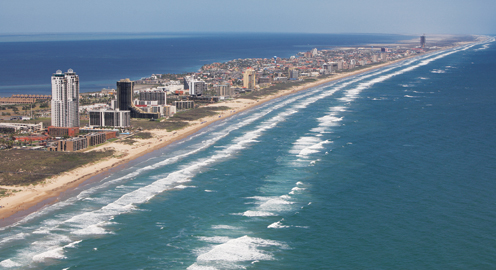
In an earlier post I mentioned the top five cities to visit in the Rio Grande Valley, and I wanted to look at one more specifically, South Padre Island. South Padre Island, affectionately called SPI by locals, is a resort town located on Padre Island. It is home to many beaches, and activities such as waterspouts, fishing, horseback riding and Schlitterbahn among others. SPI is one of the most popular Spring Break locations in the country, having several thousand college students come throughout the month of March. The photos below show the beach at SPI during Spring Break and just a normal picture of the beach.


The Summer is the busiest time of the year for SPI, where it attracts families from all over the world, while the fall and winter months there is not many people. However, SPI is still popular because many people form farther north go there to escape colder climates.

South Padre is a great beach and definitely one of the benefits of living in the Rio Grande Valley.

Looking at the Rio Grande Wikipedia

I looked at the Wikipedia page for the Rio Grande Valley and noticed that there many flaws in it. As the first place that a person who is researching the Valley would look, this is unacceptable. First, the page appears to just be the Brownsville Wikipedia with only the opening paragraphs changed to reflect the Rio Grande Valley. This is especially evident when you look at the demographics section. Early in the article, the author says that "the U.S. Census Bureau estimated the population of the Rio Grande Valley at 1,305,782". However, in the next section there is a demographic breakdown in which provides a much smaller number closer to the population of Brownsville.

Below you can see the section that I am referring to:

As of the census[10] of 2010, there were 175,023 people, 49,871 households, and 41,047 families residing in the city. The population density was 1,207.1 people per square mile (466.0/km2). There were 53,936 housing units at an average density of 372.0 per square mile (143.6/km2). The racial makeup of the city was:
Hispanic or Latino (of any race) – 91.28%
Mexican – 73.93%
Puerto Rican – 0.15%
Cuban - 0.11%
Other Hispanic or Latino – 17.08%
Not Hispanic or Latino – 8.72%
White alone - 7.75%[11]

This is vastly different from the figure before, so I decided to change the article myself based on research I found.

With my edits the article looks like this:

As of the census[1] of 2010, there were 1,264,091 people, 358,867 households, and 295,334 families residing in the Area. The population density was 295.7 people per square mile (114.1/km2). There were 416,777 housing units at an average density of 97.5 per square mile (37.6/km2). The racial makeup of the city was:
Hispanic or Latino (of any race) – 89.99%
Mexican – 83.81%
Puerto Rican – 0.23%
Cuban - 0.10%
Other Hispanic or Latino – 10.01%
Not Hispanic or Latino – 5.85%
White alone - 8.60%[31]

After looking at the 2010 Census, which the article also used, I added up the demographics for the four counties that make up the Rio Grande Valley to give my these numbers. And now the Wikipedia page is a little bit more accurate.

A Family Fun Summer Activity

While the Rio Grande Valley has plenty of activities that families can do; however, during the summer these activities are not that fun because of the extreme heat. There is one place how ever that does not suffer from heat, and that South Padre Island. Being located on the coast South Padre often has a cooler temperatures, compared to the rest of the Rio Grande Valley. Therefore, many families will go the island. However, one of the most famous family fun activities on South Padre is Schlitterbahn Beach Waterpark. Schlitterbahn South Padre Island is one of several water parks owned by Schlitterbahn a company based in Texas. The park in South Padre has many rides which you can ride. Including the Tempest, Storm Chaser, Sea Blaster, and the Gale Force. Much of the park is traversed by riding flowing tubes through a river, but it also has many land activities, such as restaurants and even some land rides. There is also beach access through Schlitterbahn and even a own hotel that one could stay at. Over all I would say that Schlitterbahn is a great time for the whole family and a must if you plan to visit the South Padre.

Message From The President

I found this video from the from the President of Mexico Vicente Fox and his response to the Donald Trump and the Wall. Although this video does not directly talk about the life next to wall. President Fox does give informative commentary and opinions that are common in the Rio Grande Valley.


I really enjoy the video and definitely believe that he give commentary that much of the Mexican American population shares.

A Look at The Wall

Hi, I wanted to show a picture of the wall, of the wall so you would be able to see what exactly the wall currently looks like, because remember, there already is a wall.


This a picture of the wall, that also shows the barrier as well as a border patrol car. I choose this picture for many reasons, because it shows the current wall, it also show a border patrol agent patrolling the border, but most importantly it is because it illustrates that the wall is not on flat ground but rather on a levee. A levee is a structure that is meant to help with irrigation and prevent flooding and therefore is actually pretty tall. This is important because it shows just how tall the walls are and that anything greater is not really needed.

An Amazing Quality of Life

THE RIO GRANDE VALLEY HAS A GREAT 

QUALITY OF LIFE


Quality of life is important when one is looking for a place to live. And the Rio Grande Valley has an extraordinary quality of life.

What exactly determines quality of life? 

The Standard of health, life, and happiness experienced by an individual or group. 


Health
  • With thriving hospitals, medical specialists & emerging practices and clinics located all throughout the Rio Grande Valley, finding dependable healthcare is not a concern.
  • There is also a new medical school that was founded at the University of Texas that also helps with a great standard of health.
Life
  • Lately the RGV has grown into a region that has everything. The stores and restaurants that only existed in the “big cities” are now commonplace. But it’s not just restaurants and name brand stores that make living in the RGV great, it’s the total package that makes life in South Texas great. 
Happiness
  • Great geography,  Our proximity to one of the state’s best beaches is a huge draw for many around Texas and as well the United States.
And to to top all of this off, the Rio Grande Valley has a very low cost of living.

RGV=80 per square foot

Manhattan= about 1700 per square foot


With all of these factors the Rio Grande Valle Really becomes a great place to live, and you can see its superior quality of life.